
Guitar News
Voyager from Le Support
Voyager from Le Support – I was very excited to try out the new Voyager model guitar support from Le Support. You might have seen my past review of the Le Support Professional model which I absolutely loved. I’ve been using the Voyager exclusively for the past two months and I can firmly say it is my favourite new guitar support. Although I miss some of the weight of the Professional model, I find the Voyager a bit more well fitted to my body and sitting position and it fits in my shoulder bag which is a huge improvement for portability. Here’s the YouTube link if you want to watch it there.
Quick Summary
The Voyager from Le Support is my favourite new guitar support and I highly recommend it. It has the same secure non-slip contact on both legs as the professional model but with a more portable design making this support a winner in terms of playability and practicality.
➔ Buy or learn more at the Le Support Voyager page
Benefits of the Voyager support- Non-slip contact on both legs (a new essential in guitar supports)
- A more compact and portable design
- Well fitted to the body and guitar
- Transparent acrylic sheet (5 mm thickness)
- Bronze inserts designed to hold the hooks and strap (sold separately)
- Soft rubber edge for comfortable use.
- Works with 3 suction cups but I also use a fourth one to be extra safe
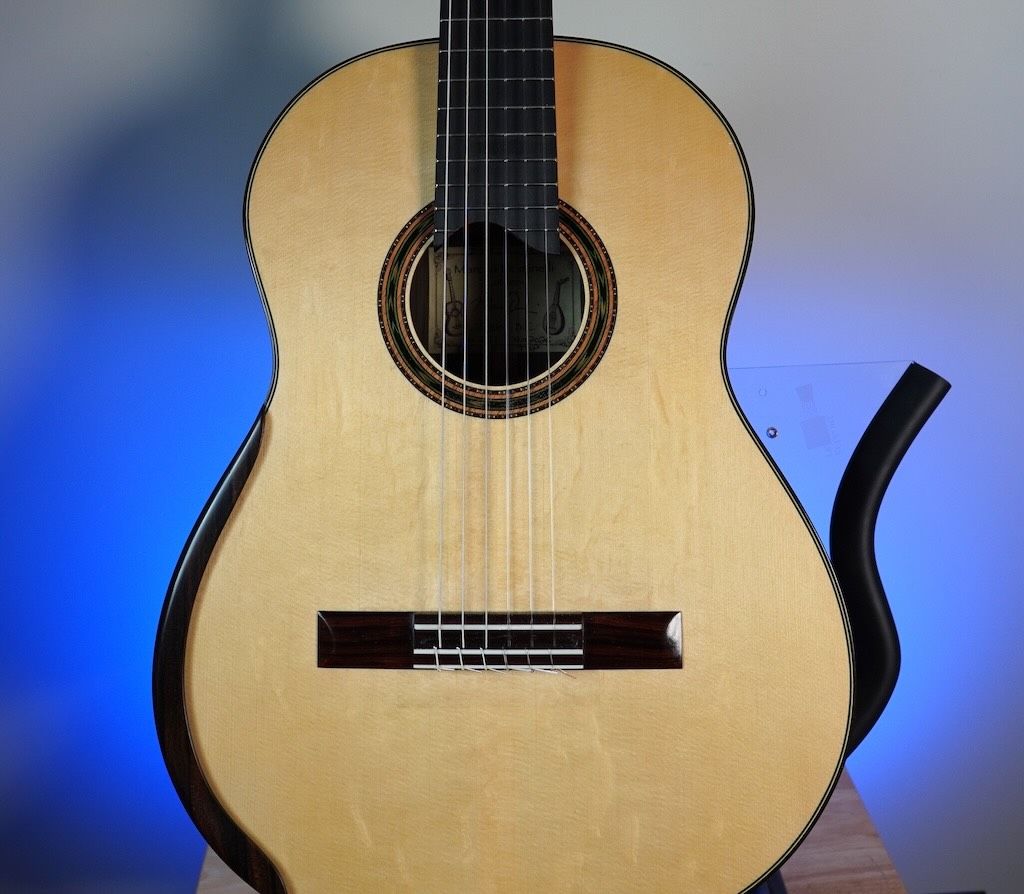
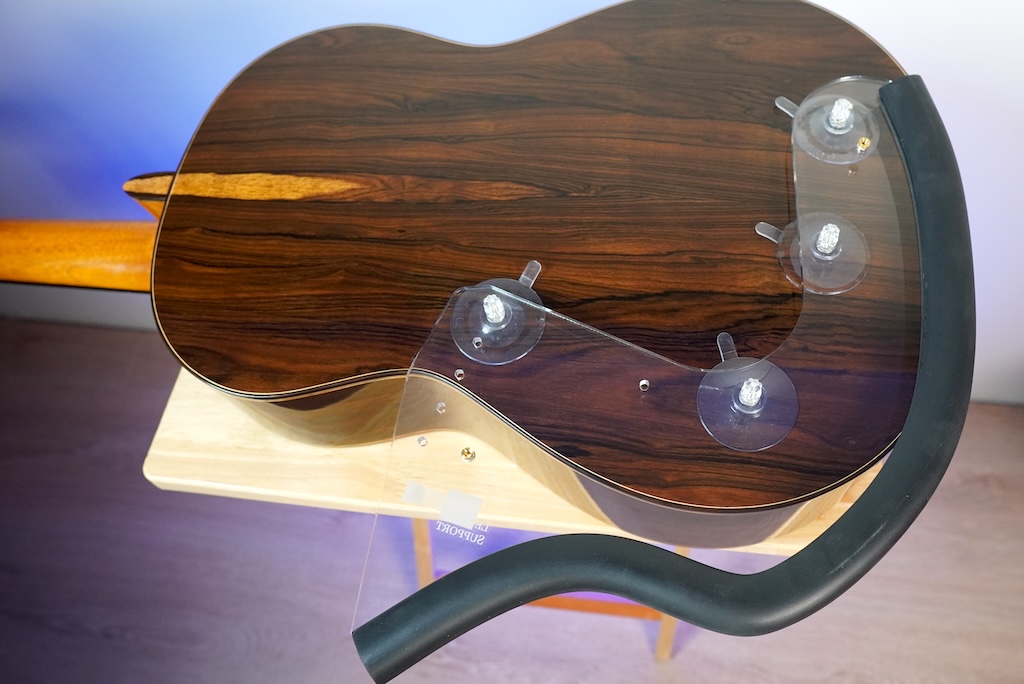
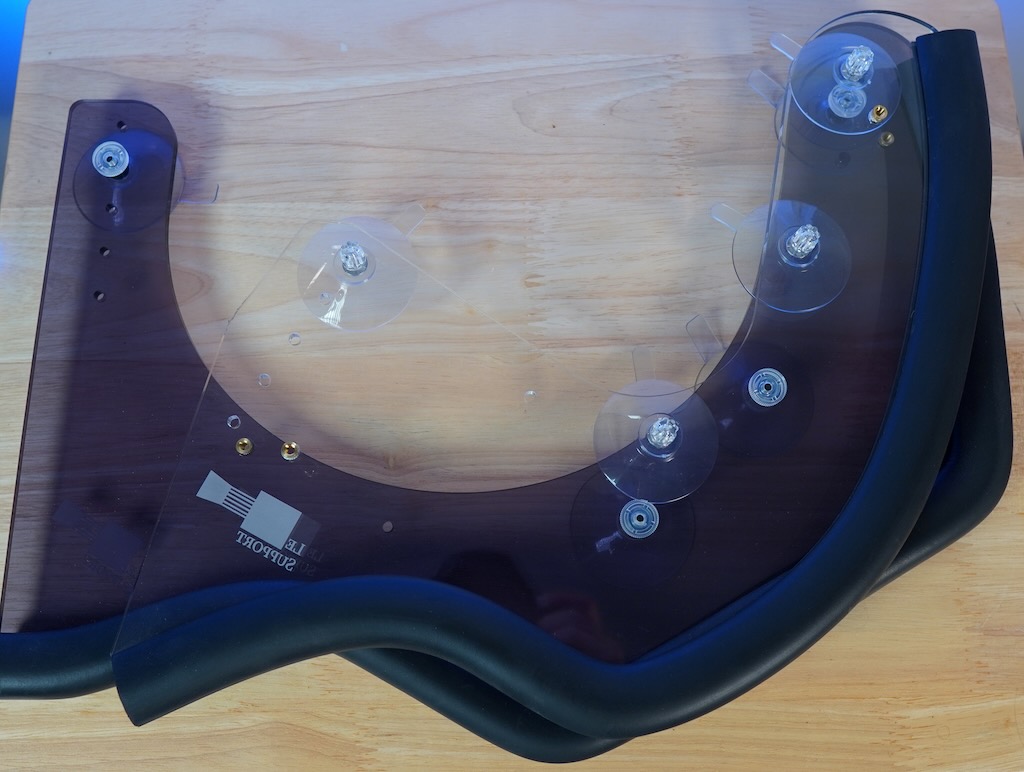
I love this support and I’m using it exclusively these days so I don’t have many concerns. I do miss some of the weight of the professional model that pulled the guitar down and made it feel a bit more stable but I also like the snug feeling of the Voyager so I think it evens out. The only concern I have is how close it is in regards to fitting my position and guitar. I’m quite short, play a small scale guitar, and like the guitar quite high so the Voyager is right near the edge of the guitar with the far suction cup (second picture above). With some chair heights I put it millimetres from the edge. But that is partly a personal oddity and I think it would likely fit 99% of people just fine. It’s working great for me at the moment.
RecommendationsI’d love to see the Voyager and Professional supports offered in a matte back 6mm thick transparent Perspex like the Guitarlift Ultimate line. Although I didn’t notice much, if any, flex in the Voyager, especially with 4 suction cups in use, I want maximum rigidity and I like the matte black appearance. This is just a personal preference comment and not a criticism as I’m loving the Voyger support.
Le Support Promotional InfoDesigned in response to feedback from users of the Professional model, this updated Le Support® VOYAGER offers the ideal balance between stability and portability. The playing feel is very similar to that of the Professional and Etude models, while adopting a more compact and portable design.
Made using a high-quality transparent acrylic sheet (12 x 12 in, 5 mm thickness), it features bronze inserts designed to hold the hooks and strap (sold separately), as well as a soft rubber edge for comfortable use. Laser-engraved logo.
Thanks to its three suction cups, it easily attaches to the back of the guitar (for guitars with French polish, using the plastic films sold separately is recommended).
Le Support® VOYAGER maintains contact points on both legs, providing excellent stability. Compact, it is ideal for guitarists seeking freedom and comfort, both at home and on the go.
Included: four tab suction cups with transparent nylon nuts.
PROUDLY MADE IN FRANCE!
via: Le Support
The post Voyager from Le Support first appeared on This is Classical Guitar.Bradford Werner Performs Studio No.6 “Soledad” by Gilardino
Bradford Werner performs Studio No.6 “Soledad” (Omaggio a Francisco Goya) from Studi di virtuosità e di trascendenza by Angelo Gilardino (1941-2022) on classical guitar. This comes via my YouTube channel. Published by Editions Bèrben. The sheet music edition can be found via Bèrben (Edizioni Curci).
This video was performed on a Marcus Dominelli classical guitar with Augustine Regal strings and a Le Support “Voyager” guitar support. See all my gear here.
The post Bradford Werner Performs Studio No.6 “Soledad” by Gilardino first appeared on This is Classical Guitar.CGC 112 : João Luiz on Brazillan Music Interpretation
CGC 111 : Tim Kain
Right Hand Fingering Concepts: Final Advice
A final word of advice for my book, Right Hand Fingering for Classical Guitar: Concepts and Case Studies. This is from my book: Right Hand Fingering for Classical Guitar: Concepts and Case Studies. This book aims to give students a basic criteria for justifying fingering choices and gaining confidence in deciding fingering for themselves. The combination of concepts and case studies offers a framework for approaching fingering in both logical and musical ways. Here’s the Youtube link if you want to watch it there.
The post Right Hand Fingering Concepts: Final Advice first appeared on This is Classical Guitar.Right Hand Fingering Concepts: Case Studies No.66-68
A lesson on right hand fingering using case studies No.66-68 which are the final case studies in the book. This is from my book: Right Hand Fingering for Classical Guitar: Concepts and Case Studies. This book aims to give students a basic criteria for justifying fingering choices and gaining confidence in deciding fingering for themselves. The combination of concepts and case studies offers a framework for approaching fingering in both logical and musical ways. Here’s the Youtube link if you want to watch it there.
This video covers Examples No.66-68 from the book (Page 54-57).
Video Times
- 00:00 Intro
- 0:51 Case No.66
- 5:06 Case No.67
- 9:48 Case No.68a
- 15:53 Conclusion
What is the best way to learn a new piece on classical guitar?
Question: What is the best way to learn a new piece on classical guitar?
Answer Summary: There are many variables involved in learning a new piece such as understanding the composition itself, the guitar techniques involved, and the comprehension and skill level of the player. Regardless, there are a few steps you can easily follow: research the main musical elements; practice the elements separately and then assemble; practice the sections evenly; examine the techniques involved and practice separately. Lets explore all the variables to get a more clear picture of how to approach a new work.
Research the main musical elementsBefore trying to play all the notes in a piece the first thing I try to decide is: what will be my musical priorities and how will I approach the piece? Here are some leading questions:
- Is there a main melodic line to play on its own?
- What will the balance of the different voices be?
- Will the accompaniment be super soft?
- Are there dynamics or articulations involved that need attention?
- Is there counterpoint? Is there more than one independent line to bring out?
- Who was the composer and what does their music sound like?
- Is there research on the piece and composer I can study?
- Period Music – What musical era is the work from and how does that era prioritize different musical elements, concepts, and expressive musicality?
- What guitar techniques are involved and do they need extra practice?
- Are there recordings of the piece I can listen to as well as other music from the era and geographic region (guitar or non-guitar listening)?
- Etc. an endless list.
This can be anything from a listening examination to a music theory analysis. Or it might just be you deciding what you believe are the musical priorities. In a common Classical era work the above questions might result in some predictable practice methods. A melodic piece with a melody, bass, and accompaniment is a common texture which we can practice in the below order:
- Practice the melody on it’s own until the phrasing and legato is at a high quality level. You might also sing the melody to really understand it musically.
- Decide the texture and dynamic balance: bring out the melody the most, then the bass voice, and soften the inner accompaniment.
- Play the notes together very slowly but try to retain the quality of the individually practiced voices.
- Raise the tempo gradually while retaining the quality level.
Don’t forget: While practicing in the above way, I might also pick a small phrase and experiment with it at a faster tempo to understand the technique requirements. In other words, take a small section and try to simulate what the end result will feel like. This can help us to understand how long it will take to prepare the work and avoid musical choices that only apply to slow practice tempos.
Examine the techniques involvedSome pieces will require a unique technique element that might need to be practiced separately. Ideally you would already be maintaining most guitar technique in a daily routine but that is not always the case and unique situations often occur.
A common example would be a tremolo piece. Maybe you would add extra tremolo exercises to your technique routine to give it a boost. Or a thick counterpoint piece might require you to add extra finger independence exercises. In unique cases you might turn a portion of the work itself into a technique exercise to master a specific situation that is unique to the piece.
Practice the phrases and sections equallyFrom the first moment you start practicing a new piece, consider assembling the whole piece somewhat evenly and slowly. Do not practice from start to finish or measure to measure.
Phrasing: Consider practicing phrases one at a time so that you are combining your technique and muscle memory with the musicality. You don’t want to develop technique hiccups in the middle of a musical phrase.
Sections: Isolate the most difficult sections and practice those more until you can play the entire work at a very slow tempo. You don’t want to get really good at the first half of the piece while the second half is weak. Consider the big picture by evening out your ability to play all sections slowly and evenly.
Some practice methods to avoid- Avoid practicing measure to measure. This can result in muscle memory that is not connected to the phrasing and musicality of the work. It’s too arbitrary, instead, pick a musical destination to play up to. One phrase at a time is better than a random measure to measure approach.
- Do not practice from start to finish. Prioritize your work by understanding which sections need more work than others.
- Do not exclusively use or avoid the metronome. I always check my pieces with a metronome to make sure I actually know how to play the rhythms accurately. This is done throughout my practice development of the work. However, in order to play with musicality that sounds natural I also will practice without the metronome. Some pieces, such as those with lots of rubato, do not benefit from metronome practice. But I still check my rhythms and tempo maintence by using it on occasion.
There are short term projects and longterm projects in music practice. When I practice a longterm piece I don’t even play it with all the notes for many weeks. I’ll start with selected musical elements, or experiment with small phrases. I’ll listen to others play the work, read and do research on the work and composer. Anything to start digesting the work without the difficulty of playing all the notes. Once I start practicing the whole piece I will have lots of insights into how to approach it and what I want the end result to look like.
Additional Topics and Lessons- Practicing and Refining Musical Textures
- Presenting and Interpreting
- Lesson on Practicing
- Practicing & Reaching Higher Levels
- Feel Stuck When Practicing
- Practicing with a Metronome
- Playing Musically on Classical Guitar
If you need clarification on this particular Q&A please leave a comment below. For new and existing questions please visit the main Classical Guitar Q&A page. If you are enjoying the free Q&As you can support the site here.
Saggese and Depedro perform Che si può fare by Barbara Strozzi
Sofia Saggese (mezzo soprano) and Davide Depedro (theorbo) perform Che si può fare (Arie op. 8, Venezia, 1664) by Barbara Strozzi (1619-1677). This comes via Edoardo Lambertenghi’s YouTube channel (go subscribe). Beautiful vocal performance, aria, and accompaniment by Depedro, pure charm.
Barbara Strozzi (1619–1677) was an Venitian composer and singer of the Baroque era, widely regarded as one of the most prolific composers of secular vocal music in 17th-century Venice. Strozzi composed a remarkable number of works, publishing eight collections of music—primarily cantatas, arias, and madrigals. She likely had more secular music in print than any other composer of the era.
The post Saggese and Depedro perform Che si può fare by Barbara Strozzi first appeared on This is Classical Guitar.Right Hand Fingering Concepts: Case Studies No.58-65 (Voice Separation)
A lesson on right hand fingering using case studies No.58-65 which focuses on voice separation and thumb use. This is from my book: Right Hand Fingering for Classical Guitar: Concepts and Case Studies. This book aims to give students a basic criteria for justifying fingering choices and gaining confidence in deciding fingering for themselves. The combination of concepts and case studies offers a framework for approaching fingering in both logical and musical ways. Here’s the Youtube link if you want to watch it there.
This video covers Examples No.58-65 from the book (Page 46-53).
Video Times
- 00:00 Intro
- 1:18 – Case No.58b
- 6:03 – Case No.59b
- 9:24 – Case No.60a
- 11:47 – Case No.61a
- 15:09 – Case No.62a
- 19:04 – Case No.63a
- 24:20 – Case No.64b
- 30:38 – Case No.65a
Kristina Vårlid Performs Variations on a Theme of Scriabin by Tansman
Norwegian classical guitarist Kristina Vårlid performs Variations on a Theme of Scriabin by Polish composer Alexandre Tansman (1897–1986), written in 1972 for Segovia, after the Prelude, Op. 16, No. 4 by Alexander Scriabin (1872-1915). This comes via Varlid’s Youtube channel (go subscribe).
Beautiful performance by Vårlid with excellent pacing and a range of delicate to pianistic playing. I award a special prize for the flicking of the 6th string with the right hand pinky finger at 1:17. Some more info via Graham Wade on this Naxos recording:
The Polish composer, Alexandre Tansman, having been introduced to Andrés Segovia during his stay in Paris in 1921, was persuaded to write for the guitar…Variations on a Theme of Scriabin, dedicated to Segovia, was written in 1972. The theme, Prelude, Op. 16, No. 4, in E flat minor (for piano), was arranged by Segovia in B minor for guitar (publ. Celesta Publishing Co., New York, 1945). This melody has a haunting quality with poignant accompanying chord progressions, though Tansman has at certain points reworked the original harmonization of the theme. The composition has six variations, the first being a transference of the theme to the bass line, with an accompaniment in the treble. Var. II, slightly faster, explores the harmonic potential of Scriabin’s melody, while Var. III is a virtuosic Vivo episode in semiquavers. Var. IV changes the tonality and explores some ingenious harmonic modulations. The fifth variation, Allegretto grazioso (quasi Mazurka), is the composer’s homage to Poland, presenting the national dance with a dash of humour and elements which evoke the music of J.S. Bach. The last variation is fugal, a contrapuntal working out of the melodic implications, which gives way to a final, slightly modified, gentle statement of the theme itself.
The post Kristina Vårlid Performs Variations on a Theme of Scriabin by Tansman first appeared on This is Classical Guitar.The Shearer Method: Classroom Guitar Year 1 & 2
The Shearer Method: Classroom Guitar Year 1 & 2
by Aaron Shearer, Thomas Kikta, and Dr. Alan Hirsh
Released 2025
Buy the Books via Aaron Shearer Foundation
The famous revised Shearer Method is now available as a Classroom Guitar series including a year one and two sequence and optional instructor’s manual appropriate for both guitarists and non-guitarist teachers. This is the most detailed and dedicated classical guitar classroom method available. Plus the online resources (video, audio, apps) for students and teachers offer clarification and continuity across the learning experience.
The inclusion of solo, duo, and trio repertoire is perfect for either small group classes or large classrooms where confidence in numbers keep students aligned. The repertoire in year one is original material which makes sense for creating a perfect match between educational content and repertoire experience. Year two includes a few arrangements of folk songs and ensemble arrangements of classical repertoire. Chord strumming exercises ensure classical guitarist learn some basics from the greater guitar world.
The biggest strength of the books might be the detailed information within the book itself and the teachers manual. This provides both teacher and student with enough content to have classroom activities and content to cover but also at-home practice reminders for students. Online videos, audio, and apps also aid students and teachers outside the classroom making the method very versatile and practical in large classes.
The content of the books include
- Developmental solos
- Student/teacher Duets. (Teacher accompaniments include chord symbols for non-guitarists)
- Developmental Guitar Ensemble in a diversity of musical styles and tailored to the sequence. Optional Contrabass parts available in Year 2
- Integrated study of Guitar Harmony
- Strumming duets to apply the learning of new chords and rhythms
- Guitar Percussion
- Online instructional videos
- Online audio support of all duets and trios
- Online Note Recognition App for supporting note reading
- Online Sight-reader App for supporting note reading
- Instructor’s Manual and online Instructor’s supplement available
All videos found via Aaron Shearer Foundation, check it out to learn more.
Example 1st Year Technique
Moderato, Ensemble No. 2, from Classroom Guitar
Shearer Foundation Virtual Forum Jan. 13, 2026
The post The Shearer Method: Classroom Guitar Year 1 & 2 first appeared on This is Classical Guitar.Right Hand Fingering Concepts: Case Studies No.54-57 (Across the Strings)
A lesson on right hand fingering using case studies No.54-57 which focuses on playing across the strings. This is from my book: Right Hand Fingering for Classical Guitar: Concepts and Case Studies. This book aims to give students a basic criteria for justifying fingering choices and gaining confidence in deciding fingering for themselves. The combination of concepts and case studies offers a framework for approaching fingering in both logical and musical ways. Here’s the Youtube link if you want to watch it there.
This video covers Examples No.54-57 from the book (Page 42-45).
Video Times
- 00:00 Intro
- 1:04 – Case No.54a
- 6:30 – Case No.55a
- 9:00 – Case No.56a
- 12:14 Case No.57a
Orlando Pellicori Performs Capriccio Diabolico, Op.85b by Tedesco
Classical guitarist Orlando Pellicori performs Capriccio Diabolico, Op.85b by Mario Castelnuovo-Tedesco (1895–1968) with string quartet and filmed on location in Corigliano-Rossano (Cosenza), Italy. This comes via the Omni Foundation and their Youtube channel (go subscribe). Originally a solo work, this is his arrangement for guitar and string quartet based on the composer’s version for guitar and orchestra.
Great to hear this work with string quartet which adds a lot of additional interest and colourful sustain. It also makes for very lush and relaxing listening in the intimate slower sections. I love hearing lots of the original switched to the quartet in the recap.
Performers
- Orlando Pellicori, guitar
- Sefora Feroleto. violin
- Vincenzo Lovallo, violin
- Giampaolo Lavorata, viola
- Aida Matera, cello
Did you know there is a Modern Repertoire category on the site? Here you can watch videos of pros playing other modern works and discover a huge variety of different styles from spacious ethereal works to lively jazz infused romps. Go here: Modern Repertoire Category for Classical Guitar
The post Orlando Pellicori Performs Capriccio Diabolico, Op.85b by Tedesco first appeared on This is Classical Guitar.How do I get a beautiful right hand tone on classical guitar?
Question: How do I get a beautiful right hand tone on classical guitar? I notice a “twangy “ sound when my finger strikes the guitar string a certain way, but a mellower sound when striking from a different position, but I don’t have consistency.
Answer Summary: The main tips for getting a nice tone on classical guitar are to consistently contact the string in the same spot from the same angle. You also need to pluck the string at an angle (not perpendicular), and direct the energy in toward the guitar rather than yank the string side to side. If you use nails you will need to have a specific nail shape and a multisided nail file to create a smooth ramp the string can glide along and release from. Let’s explore all these elements more closely below.
Tone Production LessonLet’s first take a look at my lesson Right Hand Tone Production, I’ve included my video below where I discuss right hand tasto and ponticello tone but also how to angle the finger on the string to create bright or warm sound. The more parallel I play the smoother and warmer it is, the more perpendicular I play the brighter it is. I also discuss how to play across the strings to compensate for string diameter. This also relies on having a good sitting position with guitar to some extent.
Nail Shape and FilingYou also have to consider your nail shape and filing technique which you can learn about in my Fingernail Lesson for Classical Guitar. I’ve included the video and a diagram below but you should see the full article for all the information. Key to refinement here is also the filing process and the multisided nail file.
The diagram from the video:
Consistent Contact Point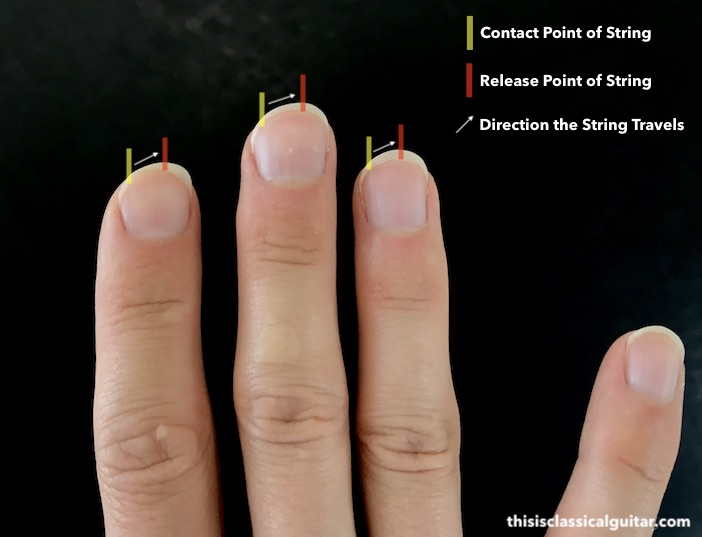
One thing discussed in both of the above lessons is string contact. The contact point of flesh and nail at the bottom of the ramp or curve of the nail must be consistent so the stroke and sound is consistent each time.
You can practice your contact point precision by practicing via Right Hand Planting & Preparation. This will help secure your playing but also help you be more consistent with the exact and predictable contact point so you start each stroke in the same way.
Questions & SupportIf you need clarification on this particular Q&A please leave a comment below. For new and existing questions please visit the main Classical Guitar Q&A page. If you are enjoying the free Q&As you can support the site here.
Avin Ahmadi Performs Gar Tīgh Bārad by Aghaei on Oud
Vienna-based Iranian oud player and vocalist Avin Ahmadi performs the Iranian piece Gar Tīgh Bārad by Siamak Aghaei on the Oud. This comes via Siccas Guitars and their YouTube (go subscribe). Beautiful performance by Ahmadi. Born in 2004, trained at Tehran’s music conservatory, she is now pursuing jazz improvisation at Anton Bruckner University in Linz, Austria.
Check out some Renaissance Music from our Sheet Music Category
The Oud and lute are directly related with the Middle Eastern oud acting as the direct ancestor of the European lute. Both are pear-shaped, plucked string instruments, but the oud is fretless with a shorter neck, while the lute, developed later, features frets and was heavily influenced by the oud brought to Europe by the Moors.
The post Avin Ahmadi Performs Gar Tīgh Bārad by Aghaei on Oud first appeared on This is Classical Guitar.Right Hand Fingering Concepts: Case Studies No.46-53 (Alternation)
A lesson on right hand fingering using case studies No.46-53 which focus on finger alternation choices. This is from my book: Right Hand Fingering for Classical Guitar: Concepts and Case Studies. This book aims to give students a basic criteria for justifying fingering choices and gaining confidence in deciding fingering for themselves. The combination of concepts and case studies offers a framework for approaching fingering in both logical and musical ways. Here’s the Youtube link if you want to watch it there.
This video covers Examples No.46-53 from the book (Page 36-41).
Video Times
- 00:00 Intro
- 0:47 Case Study No.46b
- 4:24 Case No.47
- 6:42 Case No.50a
- 10:45 Case No.51a
- 4:35 Case No.52a
- 19:14 Case No.53a
Sergei Gudelev Performs Crystal Silence by Chick Corea
Sergei Gudelev performs Crystal Silence by Chick Corea (1941-2021), arr. by A. Марков. This comes via his Youtube channel (go subscribe). I don’t usually post arrangements of jazz works but this was a beautiful performance with a wonderful spacious quality and really nice guitaristic touches that sound at home in the style. Attention to sustain and phrasing is also a joy to listen to.
The post Sergei Gudelev Performs Crystal Silence by Chick Corea first appeared on This is Classical Guitar.Zsombor Sidoo Performs Atemzüge für Thomas by Wolfram Schurig
Hungarian classical guitarist Zsombor Sidoo performs Atemzüge für Thomas (Breaths for Thomas) by Wolfram Schurig (b.1967). This comes via Sidoo’s YouTube channel (go subscribe). Beautiful performance with excellent pacing, just enough to be spacious but also complete the sustained lines.
The last two times I’ve featured Sidoo he was playing Bach so it’s great to hear him in this contrasting style. Here’s a little bio of Schurig via ircam where the composer is quoted:
It was and still is less a question for me to elaborate a personal style or to consolidate a constraining musical language, whose vocabulary — once established — must be worked on with self-referential assiduity. Rather, it seems important to me to find a path in which musical perception and — on this basis — artistic experience always become different and, in the best case, always new.
The post Zsombor Sidoo Performs Atemzüge für Thomas by Wolfram Schurig first appeared on This is Classical Guitar.How to Play Rest and Free Strokes at the Same Time on Classical Guitar
Question: How do I play rest stroke thumb with free stroke fingers at the same time on classical guitar?
Variant: How do I play free stroke thumb with rest stroke fingers?
Answer Summary: The ability to play each technique separately and to have a rest stroke technique that is relaxed, smooth-moving across the strings, and predictable is key to success. Proper finger movement and planting (preparation) technique also contribute to a simultaneous release. But there are other variables depending on the level of the student, their skills with each individual technique, relaxation, confidence, nail shape, and more. Let’s explore what’s needed in more detail.
Here is the YouTube link in case you want to watch it there.
Rest and Free Stroke AbilityHere are some combinations that need to be practiced before attempting to play a rest stroke with simultaneous free stroke.
- Free stroke thumb
- Rest stroke thumb
- Free stroke fingers
- Rest stroke fingers
- Alternating one note rest stroke and one note free stroke continuously
- Free stroke thumb and fingers together
There are two key elements important to the above:
- The ability to play flowing rest strokes that glide through the string easily and predictably. This is usually taught by developing a very light, relaxed, and flowing rest stroke. Later, the stroke can be more intense but without losing the easy glide across the strings.
- The ability to keep your right hand in the same position for both rest stroke and free stroke.
Try This: Alternating one-note-rest-stroke followed by two-notes-free-stroke continuously with i-m without a hand position change. This is essential and will allow you to combine the two techniques using only one hand position. Having different hand positions for each technique will making it very difficult to play them together.
Additional Tips for Simultaneous ReleaseMovement and Nails – Predictably of the stroke will result in simultaneous release from the finger or thumb. If you are not using nails, focus on the movement of the fingers through the string. If you use nails, make sure your nails are of somewhat even length and that the release is smooth and easy. See my nail lesson here.
Contact Point – Having a consistent contact point and release point on the fingertip or nail is very important. See my nail article even if you play without nails as the diagrams explain it.
Planting – When beginning to combine the two techniques try using long-contact planting in the right hand. Planting is a preparation on the string where contact is made and held before the stroke is executed. Be sure the plant places the string at the exact same spot on the fingertip (or fingertip with nail) so the stroke will be the same each time. A long-contact plant with a confident stroke will result in more predictability.
Move the fingers into the palm with confidence – Hesitation or trying to micromanage the technique will likely result in random release times.
You’ve made it really far! Remember that if you are even playing this at all you’ve come a long way. Congratulations. But now you are in the refinement stage which is a great place to be. It may take some time to work this out but just dedicate a few minutes a day to it and enjoy your practice session.
Questions & SupportIf you need clarification on this particular Q&A please leave a comment below. For new and existing questions please visit the main Classical Guitar Q&A page. If you are enjoying the free Q&As you can support the site here.
The post How to Play Rest and Free Strokes at the Same Time on Classical Guitar first appeared on This is Classical Guitar.Right Hand Fingering Concepts: Case Studies No.41-45 (Common Textures)
A lesson on right hand fingering for common textures using case studies No.41-45. This is from my book: Right Hand Fingering for Classical Guitar: Concepts and Case Studies. This book aims to give students a basic criteria for justifying fingering choices and gaining confidence in deciding fingering for themselves. The combination of concepts and case studies offers a framework for approaching fingering in both logical and musical ways. Here’s the Youtube link if you want to watch it there.
This video covers Examples No.41-45 from the book (Page 29-35).
Video Times
- 00:00 Intro
- 1:20 Case Study No.41b
- 3:10 Case No.42a
- 6:20 Case No. 43a
- 9:45 Case No.44a
- 13:00 Case No.45a
- 16:00 Summary